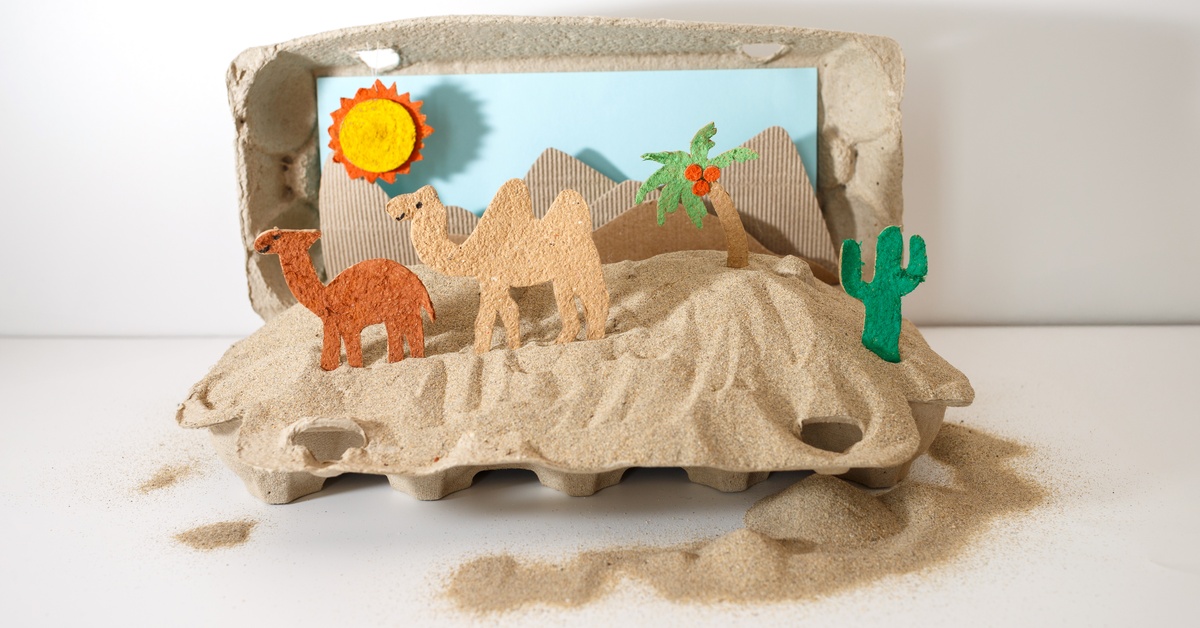
Before you flatten that delivery box for recycling day, hand it to the kids and tell them they are in charge of designing a national park. Their mission: make a cardboard national park craft with whatever is already hiding in the recycling bin, craft stash and junk drawer.
This is the kind of project that starts with “let’s just use what we have” and turns into a tiny world with trails, signs, animals, bridges, and caves. It is part craft project, part STEM activity, and part screen-free pretend play, which is my favorite kind of parenting win.
Gather Your Park Supplies
You can keep this project simple or go full “miniature theme park” if your kids like details.
Start with:
- A shipping box, cereal box or shoebox lid
- Extra cardboard scraps
- Paper towel tubes
- Egg cartons
- Craft sticks
- Construction paper
- Markers or crayons
- Glue, tape, or glue dots
- Cotton balls
- Bottle caps
- Small rocks, leaves, or twigs
- Toy animals, action figures, or little paper characters
If your kids already love doing crafts with cardboard, this project gives them a focused mission: turn one box into a whole pretend destination.
Younger kids can decorate, color, and place animals. Older kids can handle more building, planning, and problem-solving.
Build the Park Base
Use one large piece of cardboard as the base. This can be the bottom of a box, a flattened shipping box, or even the lid from a shoebox. Do not worry if it is bent or has an old shipping label on it. That is not trash. That is terrain.
Ask your kids what kind of park they want to build. A forest park? A desert canyon? A mountain overlook? A cave trail? A totally normal park with one dragon cave because apparently dragons live everywhere now?
Once they pick a theme, sketch the main areas lightly with pencil or marker. A simple layout might include a welcome area, main trail, ranger station, river, lookout point, campsite, and wildlife area.
Fold cardboard scraps to make hills and cliffs. Paper towel tubes can become trees, mountains, or tunnels. Egg cartons make great rocks or cave entrances. Blue construction paper works for water, and cotton balls can become clouds, snow, or waterfall foam.
This is a kid project, so the mountains do not have to be geologically accurate. If one hill looks like a lumpy taco, congratulations. Welcome to Lumpy Taco National Park.
Add Ranger Details, Trails, and Wildlife
Every national park needs a place where visitors can get maps and ask questions. Kids can make a ranger station from a small box, folded cardboard, or a paper cup turned on its side. Add a paper roof and a sign that says “Ranger Station” or “Visitor Center.”
Then let them fill the park with details. Craft sticks make great signs for cave trails, waterfall walks, wildlife crossings, scenic overlooks, and campgrounds. Bottle caps can become stepping stones. Twigs can become logs, bridges, or fences.
Kids can also make paper maps, ranger badges, binocular stands, lost-and-found boxes, and park rules. “Do not feed the bears” is classic. “Do not let the squirrels drive the shuttle bus” is also valid.
For wildlife, use toy animals, paper cutouts, or pom-pom creatures. Add animal tracks with markers, a frog pond from blue paper, a bear cave from an egg carton, or a bird nest from shredded paper.
This is where the playset starts to feel like a real pretend world. Toy figures can hike the trail, cross the bridge, get lost near the cave, ask the ranger for help, or take a dramatic vacation at the scenic overlook.
Create Adventure Cards
Adventure cards keep this from becoming a one-and-done craft that immediately gets shoved onto a shelf.
Cut small rectangles from paper or index cards and write simple missions on them. Kids can draw pictures on the cards or create more detailed challenges.
Try missions like:
- Find three animal tracks.
- Repair the broken bridge.
- Draw a new trail map.
- Rescue the lost hiker.
- Build a safer lookout point.
- Pick up pretend litter.
- Spot five animals.
- Design a secret trail.
The cards turn the playset into a game. Kids can pull one card at a time, complete the mission, and add something new to the park.
You can even tuck extra signs, trail pieces and mission cards into a screen-free craft kit for restaurants, road trips, or days when everyone needs something to do that does not involve another app.
Sneak in STEM Without Making It Homework
This project has plenty of STEM hiding inside the glue and cardboard scraps.
Ask simple questions while kids build:
- Why does that tower keep falling over?
- How can we make the bridge stronger?
- Which trail is easiest for a toy figure to follow?
- What happens if the mountain is too steep?
- How would visitors know which path is safe?
Kids can test, fail, rebuild, and test again. That is engineering. It just happens to be covered in marker ink and tape.
Older kids can add a scale map, compass rose, trail legend, or park brochure. If you have a 3D printer, they could design tiny signs, animals, trees, or ranger accessories.
Make It Your Own
The best part of this cardboard national park playset is that it can grow over time. Today, it might be a forest trail. Tomorrow, it might get a cave tour, a waterfall, a zipline for action figures, or a mysterious restricted area.
Younger kids might focus on coloring signs and placing animals. Older kids can engineer stronger bridges, design harder trails, or create a whole set of ranger missions. That makes the project flexible for a wide range of school-aged kids.
If your kids get hooked on designing trails, landmarks, and pretend worlds, let them sketch a kid-friendly wall design for a basement or playroom that uses color and shapes to make a blank wall feel like part of the adventure.
That does not mean you need to turn your basement into a theme park. It can be as simple as asking kids how colors guide people, why paths make play more exciting, or how a blank corner could become something imaginative.
Save the Box for One More Adventure
Having your child build A cardboard national park craft checks a lot of boxes. It uses recycled materials, keeps kids busy, sneaks in STEM, encourages storytelling, and gives them a reason to create.
It is also forgiving. If the trail is crooked, it is scenic. If the tower leans, it has character.
So, before you toss that next cardboard box, give it one more job. It might become a mountain, a river, a ranger station, or a dragon-approved scenic overlook.